Ethereum – What BitMine’s $6.3B loss reveals about building treasury around ETH
英語の原文翻訳を見る
文字サイズ本文を読む ↓
画像を読み込み中
BitMine’s heavy ETH exposure highlights the risks of Ethereum accumulation.
The SEC has released BitMine’s Form 10-K.
According to the filing, the firm suffered a $6.3 billion net loss during the fiscal year ending August 31, 2026.
As the fiscal year runs from September 2025 to August 2026, the reported loss largely reflects Ethereum’s price decline following the October 2025 crash, which pushed ETH from a peak above $4k toward $2k.
In essence, much of the $6.3 billion loss came from unrealized losses on its ETH holdings.
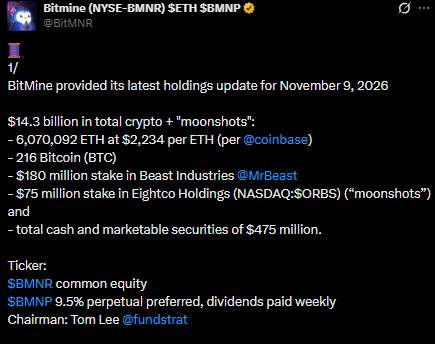
The timing of the filing is also notable. BitMine has recently disclosed that it holds 6.07 million ETH, 216 BTC, and $475 million in cash and marketable securities. It also holds a stake in Beast Industries and Eightco. Altogether, its crypto, cash, securities, and moonshot investments were valued at $14.3 billion.
Source: X
Why does this matter?
This demonstrates that the company has a large asset portfolio despite the large amount of paper loss they face. However, with ETH prices under pressure, continued accumulation also increases its exposure to further unrealized losses.
This brings attention to the recent thesis that Vitalik Buterin put forward regarding a new ‘store of value’ story. As previously covered by AMBCrypto, Buterin’s thesis aims to shift focus away from Ethereum’s deflationary model and instead focus on real demand for the asset.
Simply put, instead of relying mainly on reduced supply to drive value, the thesis puts greater emphasis on real demand and network adoption.
However, with BitMine alone losing $6.3 billion, it becomes an issue of whether the “demand-driven SOV” story holds when even the largest institutions holding ETH are losing significant sums.
This raises a key question: Does this put Ethereum’s long-term store-of-value narrative at risk?
Does BitMine’s $6.3 billion loss expose the risks of Ethereum accumulation?
For BitMine to get back into the green, Ethereum [ETH] would need a rally of nearly 50%.
However, the broader market signals suggest that recovery may not come easy. E
thereum has already underperformed Bitcoin by over 2x in Q4, falling nearly 25%. If the trend continues, the $2,000 level could come under pressure, pushing BitMine’s 6 million ETH holdings deeper into unrealized losses and adding more strain to its balance sheet.
Notably, the risk of holding such a large ETH position may also be starting to rise.
According to on-chain data, another 1,000 ETH worth $2.03 million was sold by one of the Ethereum Foundation’s wallets. Over the past week, large holders have sold a total of 17,800 ETH worth about $40 million. Meanwhile, BlackRock moved another $151 million worth of ETH to Coinbase Prime.

Source: X
In essence, bulls are still not fully buying into Bitmine’s demand-driven SoV thesis.
Against this backdrop, Bitmine’s $6.3 billion in unrealized losses could put upward pressure on this scenario. As shown in the post above, BMNR is being seen by the market as a major catalyst for Ethereum becoming a SoV asset.
However, this narrative could face a reality check if ETH continues to underperform and Bitmine’s losses keep growing.
Thus, while BitMine’s 6 million ETH holdings suggest strong institutional demand, its recent SEC filing also demonstrates the dangers of such heavy accumulation, putting Ethereum’s long-term SoV story to the test.
Final Summary
• BitMine’s $6.3 billion loss shows the risks of holding such a large amount of ETH as prices fall.
• While its 6 million ETH holdings signal strong demand, growing losses could challenge Ethereum’s long-term SoV story.