Ethereum: Glamsterdam on the way after devs schedule Hoodi testnet run for December 15
Reading sizeRead report ↓
Loading image
Ethereum's Glamsterdam upgrade gets the green light, but can it revive network activity?
Ethereum developers have agreed to move ahead with the next step in the Glamsterdam upgrade.
The key takeaway? Reaching consensus was not easy. Developers flagged potential network disruptions and usability issues with the new gas opcode. Still, they decided to proceed with it. In fact, the team also agreed to schedule the Hoodi testnet upgrade for 15th December at 7:12 PM UTC, moving Glamsterdam testing closer to implementation. So, what does this tell us?
As highlighted in the developer’ discussion, Ethereum is emphasizing post-quantum security within its development, in addition to focusing on on-chain enhancements. Simply put, regardless of the ongoing concerns, the developers are clearly moving away from just looking at scaling and speed, and towards ensuring Ethereum is future-proof in relation to quantum computing.
The meeting focused on deciding the scope and timing of the Glamsterdam upgrade and the prioritization of post-quantum security features. The execution layer teams reached a rough consensus to proceed with the current Glamsterdam spec as is, with the Hoodi testnet upgrade scheduled for December 15 at 7:12 PM UTC.
Interestingly, this was also reflected in the debate around the upcoming Heze upgrade.
There was debate about whether to support Fossil or to place a bigger emphasis on post-quantum work. Concern was expressed that Fossil may also require development effort. Though no conclusion was reached, the matter will be discussed further at the next team meeting. Meanwhile, Kevaundray suggested that Keccak256 should be used as the hashing algorithm for Ethereum’s post-quantum work.
Against this backdrop, the Heze upgrade moving forward does not seem far-fetched. With the Hoodi upgrade scheduled and Keccak256 proposed for post-quantum security, Ethereum’s [ETH] focus on strengthening its long-term security is now becoming clearer.
Hoodi testnet puts Ethereum’s network efficiency in focus
The Hoodi testnet is a testing version of Ethereum that allows developers to trial upcoming upgrades.
Think of it as a testing ground where developers can identify bugs and ensure upgrades like Glamsterdam work smoothly before reaching Ethereum users. Within the wider scope of Ethereum’s post-quantum development, it may also be used to test new security features, again allowing developers to analyze how prepared they are to then apply these to the mainnet.
That makes Hoodi an important test for Glamsterdam, giving developers a clearer picture of whether the upgrade is ready for mainnet. Why does this matter? Well, Glamsterdam aims to improve transaction processing. If successful, these changes could strengthen Ethereum’s network fundamentals. Here, the timing matters too.
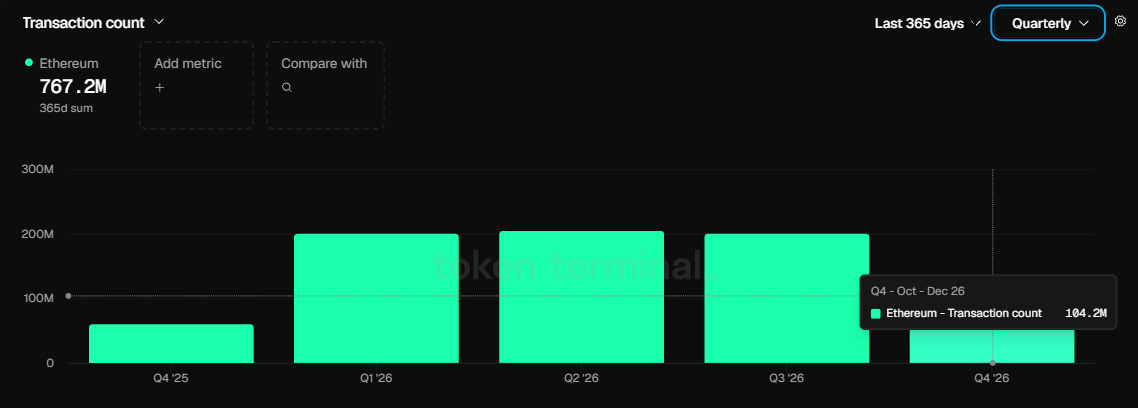
Source: Token Terminal
As the chart shows, Ethereum has processed just over 100 million transactions in Q4 so far. By comparison, the network averaged more than 200 million transactions per quarter in 2026. This puts Q4 activity well below its recent pace, with ETH’s technical structure also showing signs of weakness.
Against this backdrop, the Hoodi testnet upgrade could mark an important inflection point for Ethereum.
A successful rollout would bring Glamsterdam closer to mainnet deployment. In turn, the upgrade could boost Ethereum’s throughput, improve execution efficiency, and support stronger on-chain activity.
Final Summary
• Ethereum developers are moving ahead with Glamsterdam while focusing more on future quantum security.
• The Hoodi testnet will help test the upgrade before mainnet, with the goal of making Ethereum faster and more efficient.